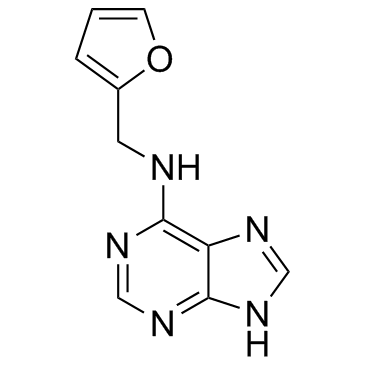
Use of 6-(Furfurylamino)purine
Kinetin (N6-furfuryladenine) belongs to a group of plant growth hormones involved in cell division, differentiation and other physiological processes.IC50 Value: Target:Kinetin is one of the widely used components in numerous skin care cosmetics and cosmeceuticals, such as Valeant products kinerase. Recently, kinetin has the potential to be a treatment for the human splicing disease familial dysautonomia.in vitro: Kinetin-induced cell death reflected by the morphological changes of nuclei including their invagination, volume increase, chromatin condensation and degradation as well as formation of micronuclei showed by AO/EB and 4,6-diamidino-2-phenylindol staining was accompanied by changes including increase in conductivity of cell electrolytes secreted to culture media, decrease in the number of the G1- and G2-phase cells and appearance of fraction of hypoploid cells as the effect of DNA degradation without ladder formation [1]. The plant cytokinin kinetin dramatically increases exon 20 inclusion in RNA isolated from cultured FD cells [3].in vivo: Subjects received 23.5 mg/Kg/d for 28 d. An increase in WT IKBKAP mRNA expression in leukocytes was noted after 8 d in six of eight individuals; after 28 d, the mean increase compared with baseline was significant (p = 0.002) [2].Toxicity: On mice with leukaemia P388, kinetin has no effect on the tumour growth, and it appears to be toxic at the dose of 25 mg/kg [4].
Names
This table lists Chinese names, IUPAC names and various aliases of this chemical substance.
| Name | kinetin |
|---|
| Synonym | More Synonyms |
|---|
6-(Furfurylamino)purine Biological Activity
This table contains bioactivity, target information and biological‑assay experimental data of this compound.
| Description | Kinetin (N6-furfuryladenine) belongs to a group of plant growth hormones involved in cell division, differentiation and other physiological processes.IC50 Value: Target:Kinetin is one of the widely used components in numerous skin care cosmetics and cosmeceuticals, such as Valeant products kinerase. Recently, kinetin has the potential to be a treatment for the human splicing disease familial dysautonomia.in vitro: Kinetin-induced cell death reflected by the morphological changes of nuclei including their invagination, volume increase, chromatin condensation and degradation as well as formation of micronuclei showed by AO/EB and 4,6-diamidino-2-phenylindol staining was accompanied by changes including increase in conductivity of cell electrolytes secreted to culture media, decrease in the number of the G1- and G2-phase cells and appearance of fraction of hypoploid cells as the effect of DNA degradation without ladder formation [1]. The plant cytokinin kinetin dramatically increases exon 20 inclusion in RNA isolated from cultured FD cells [3].in vivo: Subjects received 23.5 mg/Kg/d for 28 d. An increase in WT IKBKAP mRNA expression in leukocytes was noted after 8 d in six of eight individuals; after 28 d, the mean increase compared with baseline was significant (p = 0.002) [2].Toxicity: On mice with leukaemia P388, kinetin has no effect on the tumour growth, and it appears to be toxic at the dose of 25 mg/kg [4]. |
|---|
| Related Catalog | |
|---|
| References | [1]. Kunikowska A, et al. Kinetin induces cell death in root cortex cells of Vicia faba ssp. minor seedlings. Protoplasma. 2013 Aug;250(4):851-61. [2]. Axelrod FB, et al. Kinetin improves IKBKAP mRNA splicing in patients with familial dysautonomia. Pediatr Res. 2011 Nov;70(5):480-3. [3]. Hims MM, et al. Therapeutic potential and mechanism of kinetin as a treatment for the human splicing disease familial dysautonomia. J Mol Med (Berl). 2007 Feb;85(2):149-61. [4]. Griffaut B, et al. Cytotoxic effects of kinetin riboside on mouse, human and plant tumour cells. Int J Biol Macromol. 2004 Aug;34(4):271-5. |
|---|
Chemical & Physical Properties
This table shows physicochemical parameters including melting point, boiling point, density, solubility and optical rotation. Missing data is marked as N/A.
| Density | 1.6±0.1 g/cm3 |
|---|
| Boiling Point | 367.6±52.0 °C at 760 mmHg |
|---|
| Melting Point | 269-271 °C (dec.)(lit.) |
|---|
| Molecular Formula | C10H9N5O |
|---|
| Molecular Weight | 215.211 |
|---|
| Flash Point | 176.1±30.7 °C |
|---|
| Exact Mass | 215.080704 |
|---|
| PSA | 79.63000 |
|---|
| LogP | -0.56 |
|---|
| Vapour Pressure | 0.0±0.8 mmHg at 25°C |
|---|
| Index of Refraction | 1.774 |
|---|
| InChIKey | QANMHLXAZMSUEX-UHFFFAOYSA-N |
|---|
| SMILES | c1coc(CNc2ncnc3nc[nH]c23)c1 |
|---|
| Storage condition | −20°C |
|---|
| Water Solubility | H2O: soluble |
|---|
MSDS
This table provides MSDS information including hazard classification, first‑aid, fire‑fighting, spill handling, operation and storage instructions.
6-(Furfurylamino)purine MSDS(Chinese) |